
The promotion announcement goes up on LinkedIn on a Tuesday morning. By lunch it's gathered two hundred reactions and a stream of comments. "Well deserved." "So proud." "Richly earned." And underneath the notifications sits a thought the person at the centre of it would never post: Is this it?
I've sat opposite enough accomplished professionals to know how common that quiet question is. Few say it out loud, but many have wondered the same thing. And if you recognise it, you're not failing at gratitude. It may simply mean the definition of success that brought your career this far no longer fits. The more useful question may not be what job should come next, but what kind of life you want to build and what role work should play within it.
That's worth saying plainly, because for decades success followed one familiar formula. Study hard. Build a career. Climb the ladder. Earn more. Retire. And to be fair to the formula, it delivered. For many people it still provides stability, a home and a way to support a family. But it was never the only way to build a meaningful professional life, just the most visible one.
The questions have changed, too. Listen to what ambitious professionals ask now, usually quietly, usually only to themselves:
- Who actually controls my calendar?
- Am I still growing, or just still busy?
- Could I work from somewhere else for a month without everything collapsing?
- If I described an ordinary Tuesday, would it sound like a life I chose?
Be honest about that last one. It tends to sting a little.
Why the Traditional Idea of Success Is Losing Its Grip
When I started out, flexibility was a favour. You asked for it once, carefully, after enough loyal years to feel you'd earned the right, and you took whatever answer came back. Nobody built a career around it. Today it's one of the first things people raise when they describe a good working life, and I hear it in almost every conversation I have.
Ambition hasn't gone anywhere, though, and I'd be wary of anyone who claimed otherwise. Money still matters. Achievement still matters. What's changed is what now sits beside them. Health. Family. Freedom. Having more choice over how your days look.
That shift rarely announces itself. It happens quietly, over years, while the calendar carries on exactly as it always has. Success has evolved. Yet many of us still organise life around work as if our priorities haven't changed.

Successful on Paper
Here's the strange thing about doing everything right. You can spend twenty years building exactly the career you once wanted, and wake up inside a life designed to the specifications of a person you no longer are.
In my work I meet this all the time, and it rarely announces itself. It shows up small. Scrolling job adverts you never apply for. Envying a friend who works three days a week, then telling yourself you couldn't. Realising the last thing that genuinely stretched you was three roles ago, and what stretches you now is only the calendar. Sound familiar?
None of that means you hate your work. It usually means something simpler and far less dramatic: your priorities moved, and your career stayed where it was.
The definition of success that pulled you forward at 30 may not fit at 45 or 55. That isn't failure, and it isn't ingratitude. It's evidence that you kept growing.
What Does Success Actually Mean to You Now?
Most career advice starts with the same question: how do I become more successful? Which quietly assumes the old definition still holds. I'd rather you asked the question underneath it. What does success actually mean to you now?
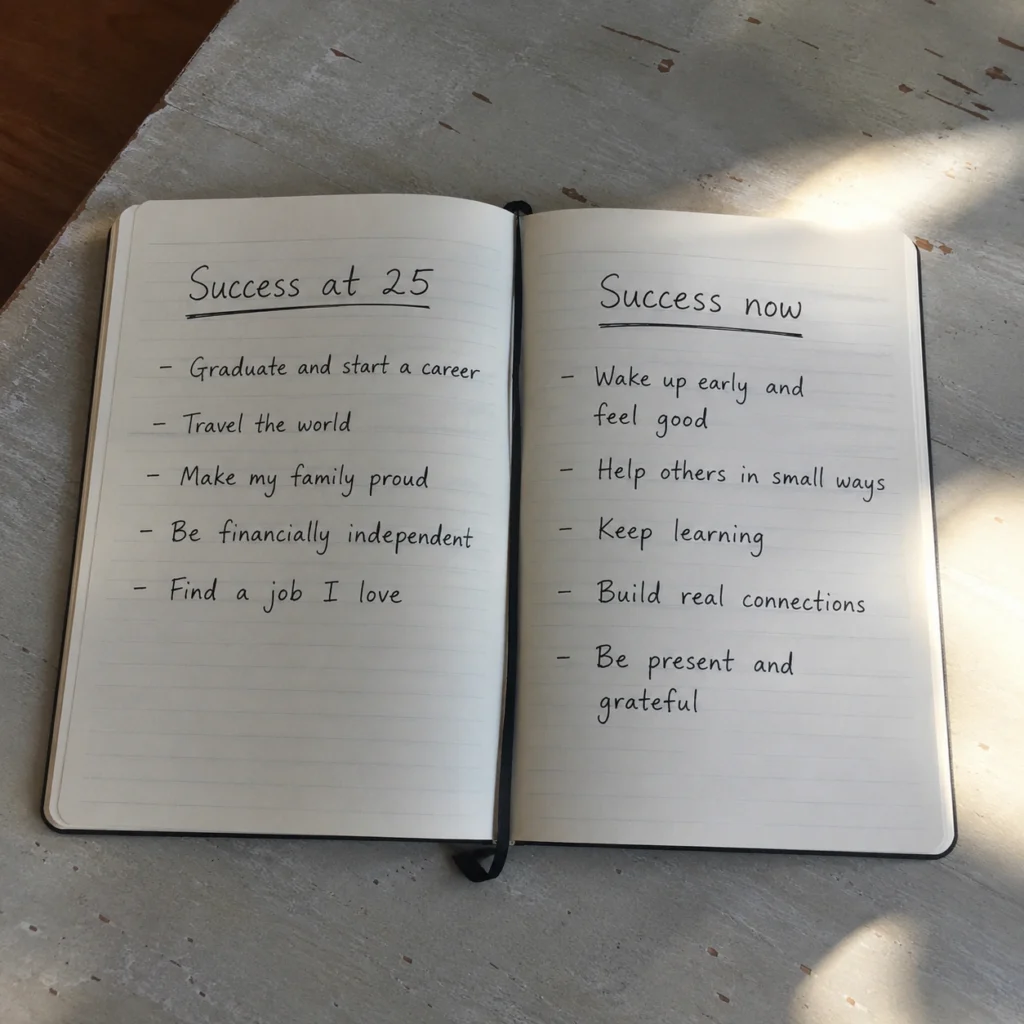
And I'd rather you answered it on paper than in your head, so try this. Write down, from memory, what success meant to you at 25. Then write what it honestly means today. Not what it should mean. What it does.
For me, success once centred on progress and responsibility. Today, meaningful work still matters, but so does having the freedom to decide how much space work occupies in my life.
Read them side by side. If you're like most experienced professionals, the second list still includes ambition, and often money too; there's nothing noble about pretending it doesn't matter. But new things appear. Freedom. Flexibility. Work that means something. More say over what an ordinary Tuesday looks like.
The gap between your two lists isn't a problem to fix. It's information. And it usually says less about the job you should have than about the life you're trying to build.
Redefining Success Starts With Your Life, Not Your Job Title
Here's where most people jump to the wrong question. Realising your definition of success has changed doesn't automatically mean changing jobs. It means looking at your life before you decide anything at all about your career.
So start there. How do you want an ordinary week to feel? Which relationships need more of your time than they're currently getting? What do you want energy left for at six o'clock? Where do health, curiosity, financial security and rest actually sit now, rather than where you'd like to think they sit? And which parts of your working life support those things instead of competing with them?
Once that picture is honest, the work question gets easier, because you're no longer asking what job to have next. You're asking what work is for, and how much room it should take up. For some people, that leads to a different role or working pattern. For others, the job doesn't change at all. What changes is the space it's allowed to occupy, the time and energy left over for health, relationships and interests, and whether every promotion still counts automatically as progress.
This is where experience helps rather than holds you back. You know by now which environments bring out your best work, which compromises you can live with and which ones cost too much. None of that disappears because your priorities have changed, which is rather the point: more experience should give you more freedom, not less. Financial security is part of the calculation too and I won't pretend otherwise. So are health, relationships, time, and the ordinary moments that make a life feel like yours.
None of it requires one dramatic move. Start by noticing where your current definition of success is asking too much of everything else. Then test one small change and see what it gives back. The aim isn't a more impressive career. It's work that supports the life around it.

The Ladder and the Wall
Perhaps the real measure of success isn't whether you've reached the top of the ladder.
Perhaps it's whether the ladder is still leaning against a wall you actually want to climb.
And if it isn't? You're allowed to move the ladder.
Success has changed. The role work plays in your life can change with it.
If your definition of success has changed, start with the life you want to build, not the job title you think should come next. Book a conversation here with me and we can explore the role work should play within that life, while taking your income needs, security and experience seriously.